
Inside a DeSoto County Property Tax Record
Reading DeSoto County property tax records starts with knowing which office keeps what. The Tax Assessor maintains the assessment roll. That office names the owner of record as of the annual assessment date, describes the parcel, and values both land and improvements. Billing is a separate job. The Tax Collector property search is the practical tool for pulling a bill or checking whether a payment posted. When a delinquent-tax receipt has been sold or an instrument has been recorded, the Chancery Clerk enters the picture. Keep those roles straight. Confusing them is the fastest way to misread a valuation as a bill, or a receipt as proof of ownership.
| Record field | Meaning in the tax trail | Primary source |
|---|---|---|
| PIN / property number | Stable parcel key used to reconcile address, roll, GIS, and bill | Assessor, GIS, Tax Collector |
| Total appraised value | County value field before the statutory class ratio | Assessor/GIS roll data |
| Total assessed value | Taxable value after the applicable assessment ratio | Assessor/GIS roll data |
| Exemption | Indicates relief reflected in the parcel data when populated | Tax Assessor |
| Bill and receipt status | Tax-year charge and online payment/receipt information | Tax Collector |
| Delinquency or sale record | Unpaid-tax process, annual sale list, or sold-tax receipt | Tax Collector / Chancery Clerk |
The GIS Tax Parcels layer exposes LANDVALUE, improvement-class fields, TOT_APVAL, TOT_ASVAL, EXEMPT, and a tax-district field. Treat those assessment fields carefully. They are not a verified sale-price history. For purchase due diligence, pair the tax record with the recorded deed and other transaction evidence.
Three DeSoto Tax Roles
Mississippi splits tax responsibility on purpose. The Assessor prepares annual values and the roll. The Tax Collector bills and collects. The Board of Supervisors sits as the Board of Equalization during the assessment-review process. The county government roles page describes the assessor's duties. Those cover ownership, legal descriptions, and tax maps, along with the collector's collection role. So route each question accordingly. A wrong value belongs first with the Assessor. A payment that may not have posted belongs with the Tax Collector. A recorded lien, deed, or sold-tax receipt may need the Chancery Clerk.
This routing also matters when records disagree. A deed recorded after January 1 can name a new grantee. The same year's assessment may still list the earlier owner. A current payment will not rewrite an archived roll PDF. Note the source, the tax year, and the query date with everything you save. No single screen is a simultaneous snapshot of the parcel.
Note: Assessment ownership, bill responsibility, and legal title can update on different schedules; reconcile by PIN and date.
Search DeSoto County Tax Bills Four Ways
The Tax Collector portal offers four distinct search modes plus roll-type and tax-year controls. Its own tips are worth following. Use a last name alone for owner searches. Use a street name alone for location searches. A location search works best with a selected year rather than "all years." Turn to property-number and tax-bill-number modes when a solid identifier already appears on a notice. An earlier record can supply that identifier too.
| Lookup choice | Input that works best | Control or caution |
|---|---|---|
| Property Owner's Name | Last name first; begin with last name only | Confirm the result by address and PIN |
| Location | House number and street, or street name alone | Select one tax year; do not use all years |
| Property Number | Exact or partial county parcel number | Displayed example format is 00-11-22-1234-5678-9111 |
| Tax Bill Number | Exact or partial bill identifier | Use the year and roll type to verify the match |
| Roll Type / Tax Year | Dropdown context for the chosen search | Dynamic option lists should be checked live |
The mode-selection screen presents owner, location, property number, and bill number as the available starting points. Open the DeSoto County Tax Collector search directly, since the live controls and notices there govern any lookup.
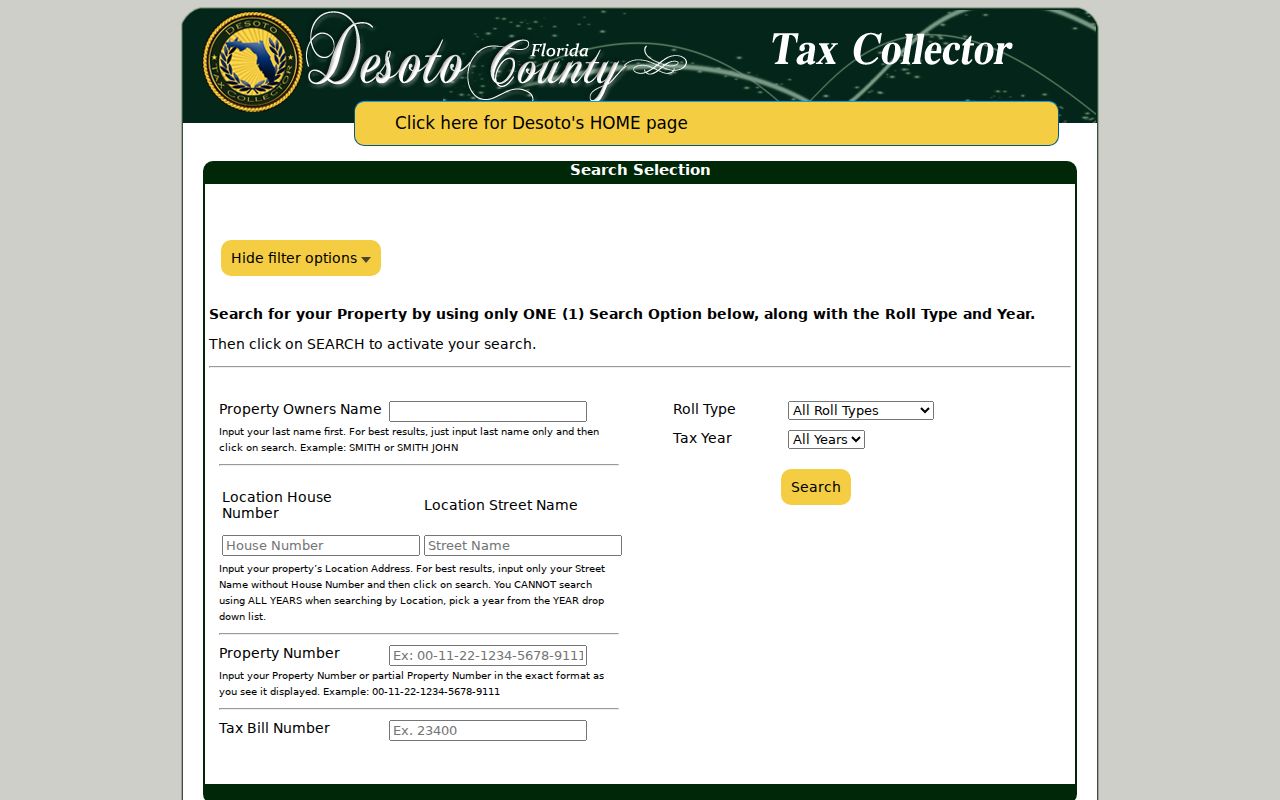
Those four modes are alternatives, not fields to fill all at once. Record the selected year with any result.
Trace a DeSoto County Assessment to Its Bill
Use a short, reproducible sequence when looking up DeSoto County property tax records:
- Search the known street address in the Tax Collector's Location mode and select the relevant tax year.
- Copy the full PIN or property number, owner label, roll type, and bill number exactly as displayed.
- Compare the parcel in the assessor/GIS record, especially total appraised value, total assessed value, land value, improvements, exemption, and tax district.
- Review the bill or receipt display, but contact the Tax Collector for an official payoff or certified current status.
- If delinquency or sale is indicated, check the county tax-sale source and the Chancery trail before drawing a title conclusion.
- Appraised or true value
- The value to which Mississippi's property-class ratio is applied; it is not automatically a sale price.
- Assessed value
- The taxable value produced after applying the statutory assessment ratio.
- Millage
- The rate applied to assessed value to calculate tax, subject to the current levies.
- Homestead exemption
- Tax relief for qualifying owner-occupied property that requires an application with the Assessor.
- Tax lien
- A claim arising from unpaid tax; its presence and current status require official confirmation.
How Mississippi Class Ratios Shape DeSoto Values
The Mississippi Department of Revenue property-tax guidance lays out the arithmetic. True or market value multiplied by the assessment ratio yields assessed value. Assessed value multiplied by millage yields the tax. The ratio depends on class. Class I owner-occupied single-family real property uses 10%. Class II other real property and Class III personal property use 15%. Class IV public utility property and Class V motor vehicles use 30%.
This is why TOT_APVAL and TOT_ASVAL can differ sharply without any error existing. Classification comes before millage and exemptions. When comparing years, keep property class, exemption status, and tax district beside each value. Comparing only the two dollar fields can hide the real cause of a change.
The Online DeSoto Receipt Is a Working Copy
The county's property-tax receipt inquiry page states plainly that online receipt information is constantly updated. But it is not the official record. That makes the online version a working copy. It is fine for narrowing a tax year, locating a bill, or preparing a question. It is not fine for certifying a payoff or settling a closing discrepancy. When an official answer matters, go to the Tax Collector. That is especially true for delinquent amounts, which can change.
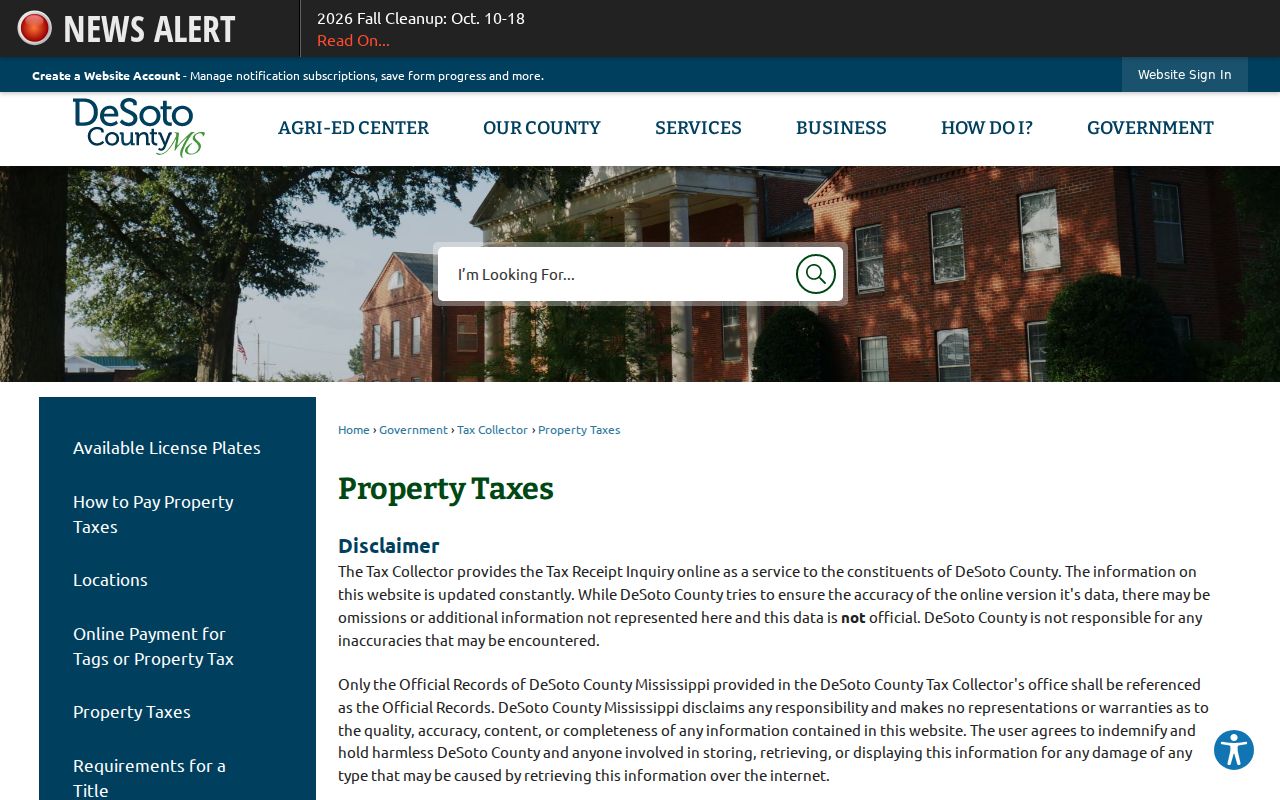
That warning matters in practice. It is a reason to save a query date and seek office confirmation before relying on a receipt. Payment terms carry their own cautions. Card and eCheck convenience fees are separate, and delinquent taxes follow an offline route. Recheck the current terms before paying, because fees and eligibility can change.
Does a paid online receipt prove clear title? No. It documents a tax payment, not every deed, lien, court order, or encumbrance affecting the parcel.
DeSoto's January-to-April Homestead Route
The county's 2026 homestead announcement set the application period from January 5 through April 1 at the Tax Assessor, 365 Losher Street, Suite 100, Hernando. It directed first-time applicants and people reporting changes to bring a copy of the recorded warranty deed and gave 662-469-8029 for questions. Those dates are a current example, not a permanent calendar: check the annual announcement before acting in a later year.
The recorded-deed requirement creates a useful bridge between tax and land records. An applicant should first make sure the warranty deed has been recorded, then bring the correct parcel identity and required application material to the Assessor. An exemption displayed in GIS is a roll field; the Assessor determines application status and required evidence.
Note: Recheck each year's homestead announcement; the 2026 dates should not be projected automatically into another filing year.
Contest a DeSoto County Assessment on the Annual Calendar
The Mississippi DOR appraisal page describes annual assessment as of January 1, followed by roll preparation and Board of Supervisors/Board of Equalization review. DOR describes the appeal deadline as usually the first Monday in August before taxes are due, but DeSoto's annual notice controls. Start with the Assessor to inspect the parcel data and learn the current protest procedure. Useful evidence may include a corrected property description, photographs, a dated appraisal, comparable information, and documents showing an error in classification or improvements.
Annual deadline controls. Confirm the current DeSoto County roll notice and Board of Equalization calendar; “usually the first Monday in August” is state guidance, not a fixed date for every year.
A dispute about dollars collected, not value, belongs with the Tax Collector. Ownership or deed problems belong with DeSoto County deed records. An assessment appeal fixes neither title nor a legal boundary.
Read DeSoto Tax-Sale Lists as Process Records
The county's Tax Sale Information page places the annual sale on the last Monday in August and posts GovEase details plus final reports, with historical reports running through 2025. An older county page gave conflicting timing, so the annual notice controls. A final list records one stage of the delinquent-tax process. It is not a deed, and it does not establish who owns a parcel now.
| Question | Best DeSoto source | Verification step |
|---|---|---|
| What is due now? | Tax Collector / Chancery source | Request the exact current payoff |
| Was it listed for sale? | Annual county notice and final list | Match year, PIN, owner, and legal description |
| Is there a sold-tax receipt? | Chancery online records or office | Request the instrument if certification matters |
| Who owns it now? | Latest recorded deed plus current roll | Do not infer ownership from the sale list |
For a parcel shown as delinquent, keep three dates distinct: the tax year, the deed-recording date, and any redemption. The safest chain runs from bill status to sale list to Chancery instrument to the later recorded deed.
DeSoto Tax Rolls Stretch from PDFs to 1837
DeSoto County's Tax Rolls page posts roll and index PDFs covering 2021 through 2025. They work well for year-over-year comparison. Each file is still a dated assessment snapshot. It is not a sale-price record. Much deeper history survives at the Mississippi Department of Archives and History Series 1202, whose finding aid lists DeSoto County tax rolls beginning in 1837 plus selected nineteenth-century years.
That long span serves property history only when identities are reconciled with care. Nineteenth-century rolls often organize entries by owner and historic land description rather than street address. Work backward with names, township and section references, deed books, and plats. Never assume a modern parcel number appears unchanged in an old tax roll.